About
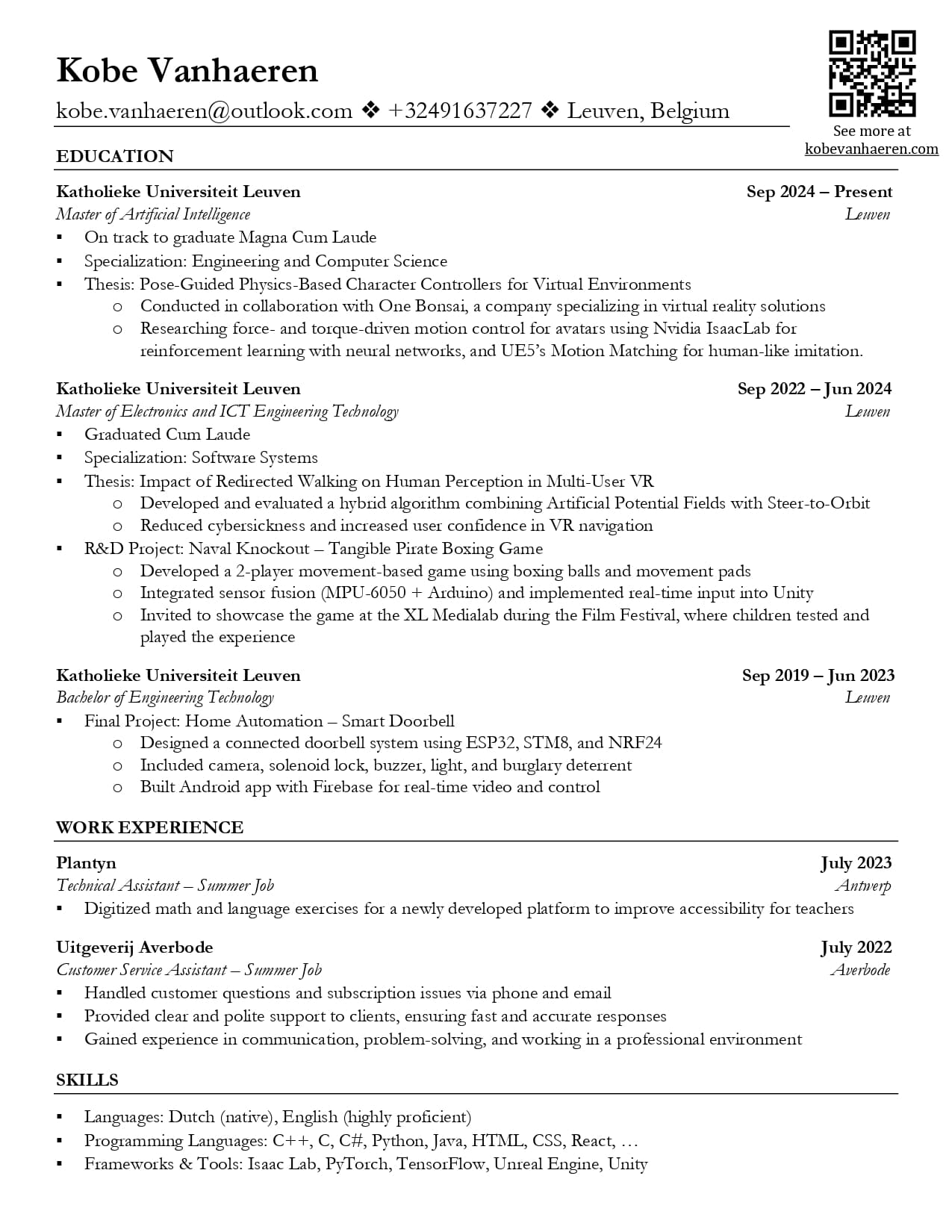
I hold cum laude master's degrees in Artificial Intelligence and Electronics & ICT from KU Leuven.
My theses were in AI and VR: reinforcement learning for physics-based character control in Nvidia Isaac Lab and Unreal Engine, and redirected walking for multi-user VR in Unity.
At Cegeka I build data and ML pipelines with Python, PyTorch, Azure Databricks, and Apache Spark, and I hold Databricks certifications in Data Engineering (Professional) and Generative AI Engineering.
Skills & Technologies
- Artificial Intelligence
- Reinforcement Learning
- Databricks
- Apache Spark
- Virtual Reality
- 3D Visualization
- Python
- PyTorch
- C++
- C#
- Unity
- Unreal Engine
Projects
A few projects across AI and VR/XR. Click a card for the full write-up.
AI Thesis: Character Controller
- reinforcement-learning
- unreal-engine
- isaac-lab
- physics-simulation
My AI thesis was about teaching a character to move with physics instead of playing back canned animations. The catch: if the reference clip is bad, the controller never gets a fair shot.
Most game characters run on kinematic rigs: state machines triggering hand-made clips. That works until physics has to carry the motion. Feet that never quite land, steps that skate across the floor, poses that look fine in a cutscene but fall apart under gravity. Physics-based controllers generate movement with forces and joint limits, so those problems stop being invisible.
The character has to earn every step: balance, recovery, timing, all under gravity. Scripting won't get you believable motion, so I wired Unreal Engine 5 to NVIDIA Isaac Lab so pose data from UE5 could flow into the training loop as reference clips. Reinforcement learning in Isaac Lab taught the policy to hit those poses with joint torques under full physics, not animation playback.
The payoff is a controller that moves like a person: fluid, adaptive, grounded. It balances, recovers from stumbles, and holds the style of the reference clip for the full run. Watching a policy stay upright through a dance sequence after an hour of training on a single GPU was the best part.
Reinforcement learning, robotics, physics simulation, and animation. This project sat right where they overlap. I got to poke at all of them.
VR Thesis: Redirected Walking
- virtual-reality
- unity
- redirected-walking
- multiplayer
This thesis was the hardest and most rewarding project I've worked on. We wanted to solve a classic VR problem: let people walk naturally in a virtual world without bumping into real walls. That's redirected walking. People have tried it before, but most methods break in small spaces or don't work when multiple users share the room.
We built a hybrid algorithm combining Artificial Potential Fields with a Steer-to-Orbit mechanic. It nudges users onto circular paths so they stay inside a confined space, even when two people are in the room at once.
To test it we made a Unity VR game: a creepy puzzle maze where you hunt for a key while getting redirected in real life. We wanted it disorienting on purpose. Tight turns, zombies, constant direction changes, all while you're walking in circles in a 6x6m room.
The results were good. Cybersickness went down, people felt more comfortable moving around, especially in multi-user sessions. They walked faster, finished tasks with more confidence, and stayed immersed. Watching people move naturally and safely in shared VR without noticing the redirection was the best part.
This project pushed me on real-time sensor processing, Unity, multiplayer networking, and user studies. It also made me more interested in VR that just works without calling attention to itself.
XR project: Point Cloud Visualization
- gaussian-splatting
- xr
- unity
- neural-rendering
We wanted to see if you could turn regular video into objects you could interact with inside an XR environment. The core technique is Gaussian Splatting, a neural rendering method that places Gaussians on a structure-from-motion point cloud to build a 3D model.
We started with video shot from multiple angles around an object, pulled frames, built a point cloud, and ran a Gaussian model on it. Even with a limited frame set the results looked sharp. Running those splats in real-time VR still isn't cheap.
Getting those splats into Unity for real-time XR meant fighting graphics API mismatches with community plugins. We splatted the hoop, the ball, and a water bottle, then built the court around them in Unity. Once they were in, we added physics: colliders, rigidbodies, and materials so the hoop and ball behaved properly in VR.
We ended up with a small game where you interact with those splatted objects in VR. ML, graphics, and gameplay in one package. The physics felt right, the visuals looked good, and I still couldn't sink a basket. Gaussian Splatting has limits. My jump shot has more.